The material is available only to
POZIRK+Łukašenka offers farmlands, subsidies to EU-blacklisted Belarusian businessman
The material is available only to
POZIRK+
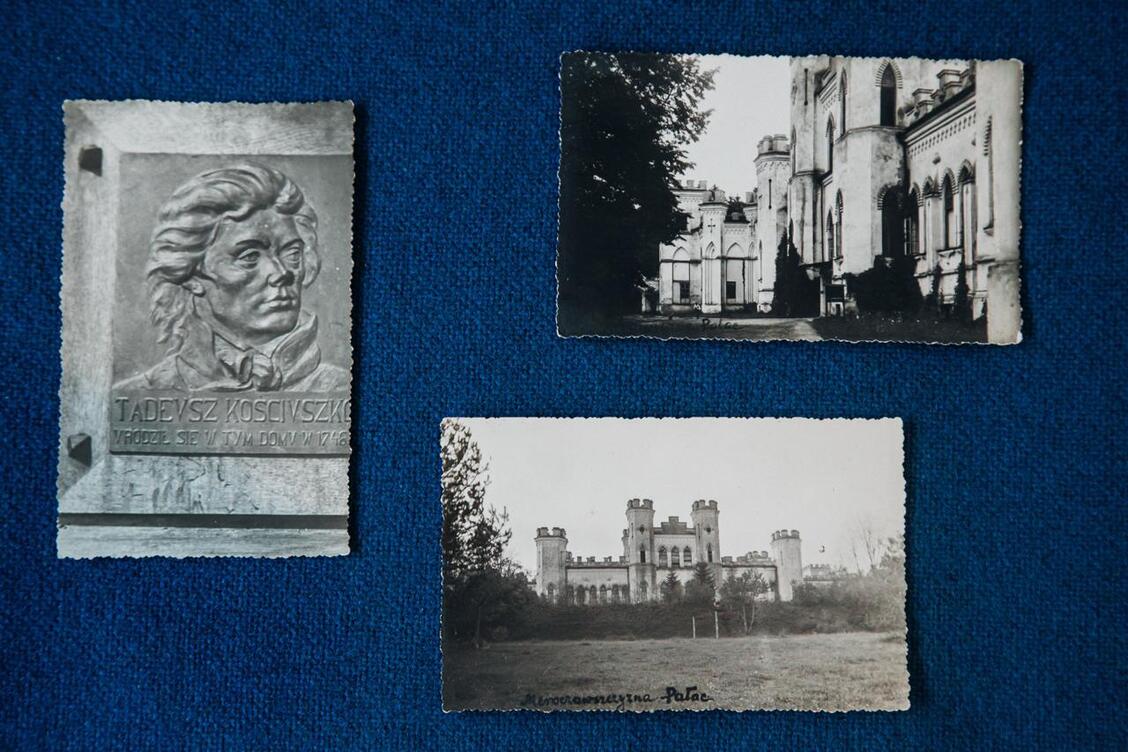
October 15, Pozirk. The MALDZIS initiative, a heritage conservation campaign financed by exiled Belarusian philanthropists, has announced the acquisition of three 1930s photographs linked to the birthplace of Tadevuš Kaściuška (Tadeusz Kościuszko), leader of the 1794 anti-Russian uprising who was born in the village of Mieračoŭščyna in what is now Belarus’ Brest region.
Kaściuška died in Switzerland on October 15, 1817.
One photograph shows a bronze memorial plaque featuring a relief portrait of Kaściuška that once hung on the house where he was born. The photo, which measures 10 by 14 centimeters (3.4 by 5.5 inches) and dates back to 1936, may be the only surviving image of the plaque.
The other two photographs depict the Pusłaŭski Palace in Kosava, also known as the Kosava Castle, and are ascribed to local photographer Józef Šimanczyk.
All three pictures bear the stamp “Archiwum płk. dr. Czesława Hake,” which translates as the “archive of Colonel Dr. Czesław Hake,” who lived and worked in Kosava between 1935 and 1937.
A museum dedicated to Kaściuška was opened in his house in Mieračoŭščyna in 1936. The initiative suggests that the bronze memorial plaque was removed from the building in 1939 after Soviet authorities took control of Western Belarus under the Molotov-Ribbentrop Pact with Nazi Germany. The house burned down in 1942 and was rebuilt on its original foundation in 2004.
The Pusłaŭski Palace in Kosava is one of Belarus’ most distinctive 19th century Neo Gothic residences, built for Belarusian nobleman Vandalin Pusłaŭski and once a major cultural center of the local nobility that included the older Kaściuška estate park.
The campaigners say that the photographs will be donated to Kaściuška’s museum in Mieračoŭščyna when the political situation in Belarus changes.
In August 2026, the MALDZIS initiative, named after the late Belarusian scholar Adam Maldzis, announced the purchase of a rare 17th-century engraving showing what the city of Brest looked like 360 years ago.
Earlier, the campaigners had acquired one of the first editions of Jan Nieprecki’s map of the Grand Duchy of Lithuania, along with several other historical artifacts.
The MALDZIS initiative brings together a number of anonymous and named contributors, including former Belarusian diplomat Pavieł Macukievič, sociologist Ryhor Astapenia, economist Pavieł Danejka and businessman Ivan Šyła.
Danejka, administrative director of the BEROC think tank, has been branded an “extremist” and a “terrorist” by Belarusian authorities and sentenced to 12 years in prison in absentia for allegedly founding an “extremist group” and conspiring to seize power.
Tadeuš Kaściuška was the central figure in the 1794 uprising against the Russian Empire aimed at restoring the sovereignty of the Polish-Lithuanian Commonwealth after its partitions by Russia and Prussia. Although initially successful, the insurrection was eventually crushed, paving the way for the final partition of the Commonwealth in 1795. Kaściuška’s legacy also includes his role in the American War of Independence, where he earned recognition as a military engineer and is still honored as a hero of the United States.